
From 1st April 2026, several important changes have been implemented that directly and indirectly impact employees’ salaries. These changes are not limited to the New Labour Code notified by the Government on 21st November 2025.
If you have carefully reviewed your payslip, you may have noticed changes in your tax deductions as well as your salary structure.
You may also have received communication from your HR department regarding salary restructuring. These reforms are not applicable only to your organization—they are being implemented across the country. In this discussion, we will explore these major changes in detail and understand how they affect your salary and overall compensation.
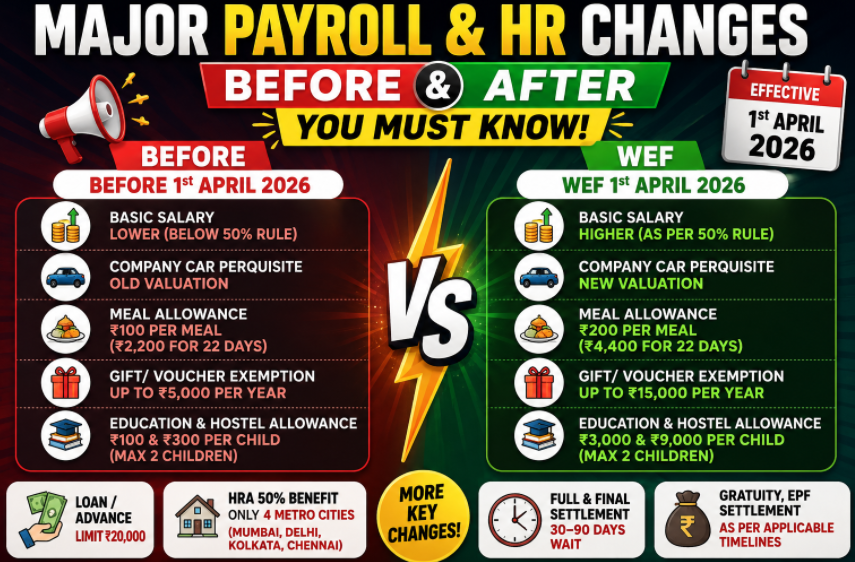
1.Code on Wages
As per the notification issued on 21st November 2025, the Code on Wages is required to be implemented with immediate effect. Following this notification, organizations across the country have started adopting the new wage structure.
One of the most significant changes introduced under the Code on Wages is the 50% Rule. According to this rule, an employee’s Basic Salary + Dearness Allowance (DA) must be at least 50% of the Total Remuneration.
Before this change, many organizations kept the Basic Salary between 25% and 40% of the CTC (Cost to Company). However, under the new wage structure, employers are restructuring salary components to ensure compliance with the 50% requirement.
This change has a direct impact on various salary components such as Provident Fund (PF), Gratuity, Leave Encashment, Bonus, and take-home salary, making it one of the most important payroll reforms in recent years.
2. The 50% of Basic Salary Rule
Under the Code on Wages, 2019, the Government introduced a uniform definition of wages that is applicable across all organizations.
According to this definition, an employee’s wages should be at least 50% of the total remuneration (CTC). The components considered under this definition include Basic Salary, Dearness Allowance (DA), and Retaining Allowance, wherever applicable.
Before the introduction of this provision, there was no prescribed minimum threshold for determining the Basic Salary and DA. As a result, many employers structured salaries with a lower Basic Salary to optimize payroll costs. The new wage definition aims to standardize salary structures and ensure greater social security benefits for employees.
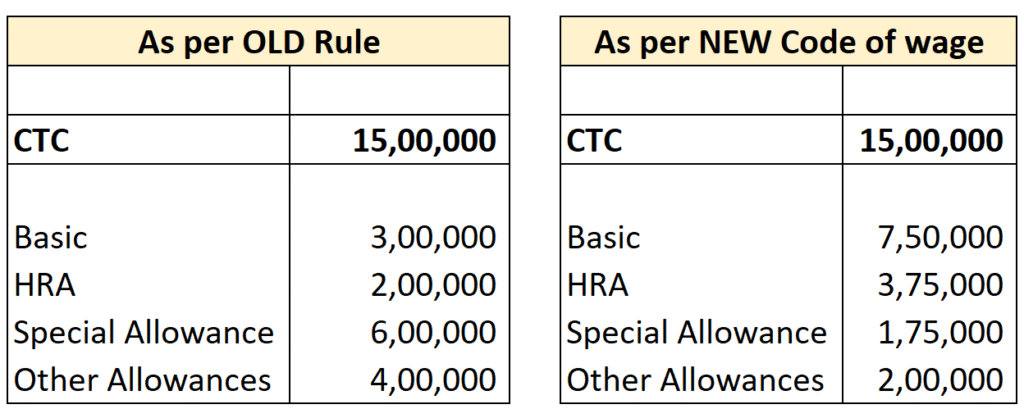
3.Impact of 50% of Basic Salary Rule
a. Rise in EPF Contribution
One of the major impacts of the new wage structure is an increase in EPF (Employees’ Provident Fund) contributions.
As per the new wage structure, the Basic Salary should generally not be less than 50% of the total remuneration (CTC). Since EPF contributions are calculated as 12% of the Basic Salary (subject to the applicable EPF rules and wage ceiling where relevant), an increase in the Basic Salary results in a higher EPF contribution.
As a result, both the employee’s and the employer’s EPF contributions may increase. While this may reduce the employee’s monthly take-home salary, it also helps build a larger retirement corpus, providing better long-term financial security.
b. Reduction in Monthly Take-Home Salary
As the Basic Salary increases due to the 50% Rule, the EPF contribution also increases because it is calculated as a percentage of the Basic Salary.
Since the employee’s EPF contribution is deducted from the monthly salary, a higher EPF deduction may result in a lower monthly take-home salary. Although employees may receive less cash in hand each month, the increased EPF contribution helps build a larger retirement savings corpus, providing greater financial security in the long run.
c. Impact on Gratuity and Other Retirement Benefits
The Code on Wages also has a significant impact on Gratuity and other retirement benefits.
Since Gratuity is calculated based on the Basic Salary, an increase in the Basic Salary due to the 50% Rule results in a higher gratuity amount payable to eligible employees. This provides better long-term financial benefits to employees but also increases the employer’s gratuity liability.
Similarly, benefits that are linked to the Basic Salary—such as Leave Encashment (where applicable under the employer’s policy), certain retirement benefits, and other statutory payments—may also increase as a result of the higher Basic Salary.
While these changes increase the overall cost for employers, they strengthen employees’ long-term financial security by enhancing their retirement and terminal benefits.
4.Car Perquisites
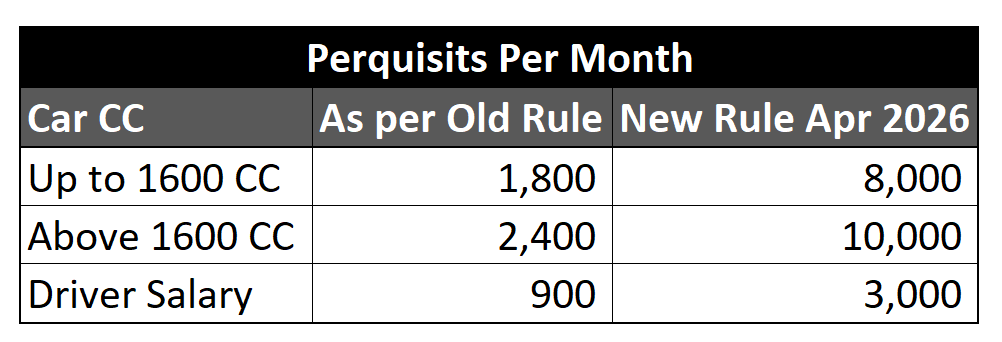
Another important change effective 1st April 2026 relates to the Company Car Perquisitevaluation for employees using aCompany Leased Vehicle (CLV).
The Government has revised the method for calculating the taxable value of company-provided cars. As a result, the perquisite value of a company-leased vehicle has changed under the new tax rules.
In the comparison shown here, you can clearly see the difference between the old perquisite valuation and the revised valuation applicable from 1st April 2026. These changes may have a direct impact on an employee’s taxable salary and, consequently, the amount of income tax payable.
5.Meal Allowance
Another important change effective 1st April 2026 is the revision in the Meal Allowance limit.
Previously, the tax-exempt meal allowance was ₹100 per working day (or as applicable under the earlier rules). Assuming 22 working days in a month, the maximum tax-exempt meal allowance was ₹2,200 per month.
From 1st April 2026, the exemption limit has been increased to ₹200 per meal. Therefore, if an employee receives one meal per working day, the monthly tax-exempt meal allowance can increase to:
₹200 × 22 working days = ₹4,400 per month This means employees can now receive a higher tax-free meal allowance, reducing their taxable income and increasing their overall tax efficiency, subject to the employer’s meal allowance policy and the applicable tax rules
6.Gifts and Vouchers
You may already be aware that, under the earlier tax provisions, gifts or gift vouchers provided by an employer up to ₹5,000 in a financial year were exempt from income tax.
However, effective 1st April 2026, this exemption limit has been increased to ₹15,000 per financial year.
This means that if an employer provides gifts, gift cards, or vouchers with a total value of up to ₹15,000 during a financial year, the amount will generally be tax-exempt, subject to the applicable rules.
If the total value exceeds ₹15,000, the entire value of the gift or voucher becomes taxable as a perquisite under the Income-tax provisions. This amendment provides greater tax benefits to employees by allowing employers to offer higher-value gifts and vouchers without creating a tax liability, provided the total value remains within the prescribed limit.
7.Children’s Education Allowance and Hostel Allowance
Another significant change effective 1st April 2026 is the revision of tax exemptions for Children’s Education Allowance and Hostel Expenditure Allowance under the Old Tax Regime.
Previously, the tax-exempt limits were:
- Children’s Education Allowance: ₹100 per month per child
- Hostel Expenditure Allowance: ₹300 per month per child
These exemptions were available for a maximum of two children.
Under the revised provisions effective 1st April 2026, the exemption limits have been substantially increased:
- Children’s Education Allowance: ₹3,000 per month per child
- Hostel Expenditure Allowance: ₹9,000 per month per child
The revised limits continue to be available for up to two children, providing greater tax relief to employees who opt for the Old Tax Regime and receive these allowances as part of their salary structure.
8.Loan Benefits and Taxability
Another important change effective 1st April 2026 relates to salary advances and concessional loan perquisites.
Previously, if an employee received a salary advance or loan from the employer up to ₹20,000, it was generally not treated as a taxable loan perquisite. However, if the outstanding loan amount exceeded ₹20,000, the loan perquisite provisions became applicable, and the employee could be taxed on the interest benefit, subject to the Income-tax Rules.
Effective 1st April 2026, this threshold has been increased from ₹20,000 to ₹2,00,000.
This means that if the aggregate outstanding amount of employer-provided loans does not exceed ₹2,00,000, the concessional loan perquisite provisions generally will not apply. Only when the outstanding balance exceeds this limit will the loan perquisite be calculated in accordance with the applicable tax rules. This amendment provides significant relief to employees by allowing higher-value employer loans without triggering a taxable perquisite, subject to the prescribed conditions.
9.Two Days Rule of Full and Final Settlement
Many employees have experienced that after resigning from a job, they had to wait 30 to 90 days to receive their pending salary, leave encashment, and other final dues.
Under the Code on Wages, employers are expected to process the Full and Final (F&F) Settlement within two working days after an employee’s separation, as applicable under the prescribed provisions.
This means that the employer should settle payments such as:
- Pending salary
- Leave encashment
- Reimbursements (if applicable)
- Other payable dues related to the final salary settlement
However, certain benefits that are governed by separate laws or processes—such as Gratuity, EPF transfer or withdrawal, and other statutory benefits—may continue to follow their respective timelines and need not necessarily be completed within the two-day F&F settlement period.
This reform is intended to ensure that employees receive their eligible dues much faster after leaving an organization, reducing unnecessary delays in the separation process.
10.HRA Tax Benefit (Metro/Non Metro City)
Until 31st March 2026, only four cities were classified as metro cities for the purpose of House Rent Allowance (HRA) exemption:
- Mumbai
- Delhi
- Kolkata
- Chennai
Employees living in rented accommodation in these cities could claim HRA exemption by considering 50% of their salary (as defined under the Income-tax Rules), subject to the prescribed HRA exemption conditions. Employees residing in other cities were eligible to consider only 40% of their salary for HRA exemption.
Effective 1st April 2026, the list of metro cities has been expanded. In addition to the existing four metro cities, the following cities have also been included:
- Bengaluru
- Hyderabad
- Pune
- Ahmedabad
As a result, employees residing in these newly added metro cities may also become eligible to calculate HRA exemption using the 50% salary limit, subject to the applicable Income-tax provisions and eligibility conditions.
This change is expected to provide higher HRA tax benefits to employees living in these major metropolitan cities.
About the Author
