
Office politics is a reality in nearly every organisation. It is inevitable. When you are a junior employee, politics may look small and harmless. But as you grow higher in your career and reach a managerial or leadership role, office politics becomes more serious, silent, and impactful.
In India, office politics at the managerial level is unavoidable because of the following reasons.
- Strong hierarchy and respect for seniority
- Limited leadership positions
- High competition for promotions
- Pressure from top management
Many talented and truthful managers fail to grow; it is not because they lack skills, but because they do not understand how to handle office politics smartly. Here we are going to cover such scenarios and will guide you to cope with such situations.
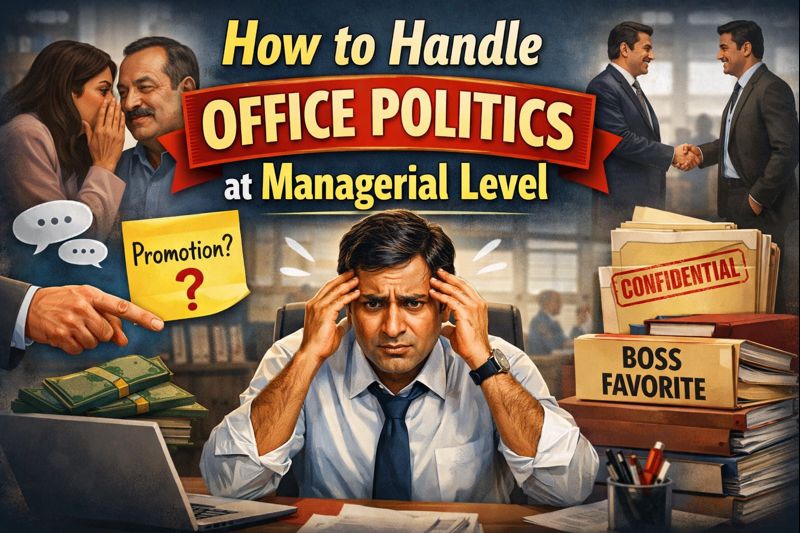
What is Office Politics at the Managerial Level?
When people use power, influence, relationships, or information to get personal advantage in the workplace, this situation is called office politics or politics.
You must heard saying this from an employee, I have completed this project, but the credit goes to another person, so such types of silent game people play.
At the managerial level, politics is not open it is a silent and strategic game which People play silently and strategic. It includes:
- Taking credit for others’ work
- Controlling information flow
- Influencing senior management
- Creating groups or lobbies
- Pushing personal agendas
Example
Rahul is a Operation manager. His team completes a complex operational project on time. In the leadership review meeting, another manager presents the outcome and shows his own contribution in a articulated way. Rahul feels confused and demotivated.
This is a common example of managerial-level office politics.
Why Office Politics Increases as You Grow
When you start your career, you seldom feel such politics, but when you grow in your career as you go to upper level there are lots of politics you will face.
So you must have one question: why do people play such dirty politics at higher levels?
1. Fewer Positions at the Top
In junior roles, there are countless positions. But at senior levels, positions are limited. Every one want to save and secure their job. And for this competition naturally increases, which leads to politics.
2. High Visibility and Accountability
In every organisation Managers are being observed in every decision, email, and presentation is noticed by senior leaders.so he is eye of Senior leaders.
3. Power and Control
Managers are position that keeps control on people, processes, and information. He leads the team so whenever the power comes, it attracts politics.
4. Ego and Insecurity
Some managers feel insecure when others perform better. So instead of improving themselves, they try to pull down other managers or take them as competitors in a different way.
Common Types of Office Politics in Indian Companies
1. Credit Stealing
A manager takes credit for team or peer work. example, Priya prepares the full project plan. Her manager presents it to the director without mentioning her name.
2. Yes-Man Culture
Some managers always agree with seniors, even when decisions are wrong, just to stay in good standing.
3. Lobby and Groupism
Managers form groups based on region, language, college, or old connections.
4. Favouritism
Promotions, ratings, or good projects are given to favourite employees, not performers.
5. Information Politics
Important updates are shared with selected people to maintain control.
How Office Politics Affects Good Managers
If office politics is not handled well, it can:
- Damage reputation
- Reduce motivation
- Increase stress and anxiety
- Slow career growth
- Create self-doubt
In India, many experienced professionals resign not due to workload, but because of toxic politics.
Detailed Indian Case Study
Rahul vs Sharma Ji – A Realistic Scenario
Rahul is an operations manager in a manufacturing company in Pune. He focuses on process improvement, safety, and team development.
Sharma Ji, another manager, focuses on staying close to the plant head. He attends informal meetings, agrees with seniors, and selectively shares information.
During reviews:
- Rahul presents data and facts
- Sharma Ji presents stories and praises leadership
Result:
Rahul’s work is strong but less visible. Sharma Ji gets more appreciation.
Key Learning:
So hard work is not alone enough at the managerial level. Hence, Smart visibility is very essential. Whatever you are doing, try to mentioned in smartly in places where you get credit for your work.
Golden Rule: Be Politically Aware, Not Politically Dirty
Handling office politics does not mean cheating, lying, or harming others, so experience says don’t play politics but be aware politically, here I have mentioned some points you should follow.
- Understanding people
- Reading situations
- Protecting your work and reputation
- Acting ethically
A smart manager plays defence, not dirty offense.
Practical Strategies to Handle Office Politics Successfully
Here I have covered some strategies which ever manager should follow to cope with dirty politics. And also it works to make your identity.
1. Build Strong Professional Relationships
Do not limit yourself to your own team, you have to like socialise person, like HR person carry this attitude.
Build connections with:
- Peer managers
- Seniors
- HR and Finance
- Cross-functional teams
Remember the good relationships always reduce isolation and increase support.
2. Increase Visibility Without Showing Off
Remember your work should be recognised, but again remember recognized does not mean that you have to do show off. You have to follow it in structured communication.
Here is some points you need to consider
- Weekly or monthly summary mails
- Data-based presentations
- Clear dashboards
Smart Example:
Instead of saying “My team did this”, say: “Our team achieved this milestone under my coordination.”
3. Document Everything
In the office, you always feel if you are doing your best, then credit goes to someone else, and if any mistakes happen in the team, then the blame games start.
So my suggestion is always maintain:
- Email approvals
- Meeting minutes
- Action trackers
4. Stay Neutral in Power Struggles
Avoid taking sides in conflicts between senior managers unless your role officially requires it. Remaining neutral helps maintain professionalism and trust. Taking sides without authority can harm relationships and credibility. Neutral managers are seen as fair and dependable.
5. Control Emotions and Reactions
Never react emotionally in meetings or emails. Always respond in a calm and composed manner.
Emotional reactions can weaken your professional image. Calm managers handle situations more effectively. Such behaviour helps you earn respect as a mature leader.
What NOT to Do at Managerial Level
Avoid these mistakes, as these actions damage credibility.
- Gossiping about seniors or peers
- Complaining emotionally
- Public criticism of management
- Blind trust in office friends
How to Handle Difficult or Political Bosses
Understand Their Pressure
Understand their pressure, as senior managers often face heavy expectations from top leadership.Recognize their challenges instead of reacting emotionally.
Align Your Work With Their Goals
Align your work with their goals to show that you support their success. Show how your work supports their success.
Choose Words Carefully
Clearly explain how your contributions help them achieve results.Choose your words carefully, because respectful communication works better than confrontation.
Office Politics vs Performance – Finding the Balance
Performance is the foundation. Without performance, politics cannot help.
Politics decides:
- Visibility
- Opportunities
- Speed of growth
The best managers balance results and awareness.
Leadership Mindset: Rising Above Politics
Great leaders: They know Consistency and integrity always win in the long run.
- Do not react to every political move
- Focus on long-term reputation
- Build trust slowly
When Should You Exit a Political Workplace?
Sometimes leaving is the best decision. Because in such a situation healthy workplace is important for long-term success.
So consider exit if you face that :
- Ethics are compromised
- Mental health is affected
- Growth is blocked for a long time
Practical Daily Habits for Managers
We are engaged in our day-to-day official activities so every manager should have some of those attitudes that make them stronger and to survive in such situations. So if you want a game changer, then follow the things below in your daily life.
- Listen more, speak wisely
- Observe before reacting
- Communicate clearly
- Build personal brand
- Stay updated
Final Advice for Indian Managers
- Be smart, not silent
- Be visible, not arrogant
- Be ethical, not emotional
- Think long-term, not short-term
Additional Real-Life Indian Case Studies
Case Study 1: IT Project Manager in Bengaluru
Ankit works as a project manager in a mid-size IT company in Bengaluru. He manages a team of 50 people and delivers projects on time. However, another project manager often highlights only his own small achievements in leadership calls and sends frequent update emails to senior management.
Over time, senior leaders start recognizing that manager more, even though Ankit’s projects are bigger and more complex.
What Ankit Learned:
- Good work must be communicated properly
- Silence is often misunderstood as low contribution
Ankit started sending clear weekly project summaries with data. Slowly, leadership noticed his impact.
Case Study 2: HR Manager in a Manufacturing Company
Neha is an HR manager in a family-owned manufacturing company in Gujarat. Promotions are influenced by relationships with directors. Performance is secondary.
Neha tried to openly challenge unfair practices and faced resistance.
Smart Move:
She shifted her approach. Instead of confrontation, she used data, compliance risk reports, and industry benchmarks.
Result: Management slowly accepted changes without ego clash.
Case Study 3: Banking Sector Manager
Ramesh works as a branch operations manager in a private bank. Regional favouritism affects transfers and promotions.
Ramesh focused on:
- Customer metrics
- Audit scores
- Documentation
When promotion discussions happened, data spoke louder than politics.
Office Politics During Appraisal and Promotion
This is the most sensitive time in Indian offices.
Common political tactics:
- Highlighting others’ mistakes
- Downplaying team effort
- Creating urgency stories
How to Handle Appraisal Politics
Prepare a yearly achievement document‘
Prepare a yearly achievement document to record your key accomplishments. Include measurable results and successful projects.
This document helps highlight your contributions clearly. It becomes useful during appraisals and reviews. It also builds confidence by showing your growth over the year
Map your work with company goals
Map your work clearly with the company’s goals.Show how your daily tasks support business objectives.This alignment proves the value of your role.It helps management understand your impact better.Such clarity improves recognition and career growth.
Share achievements periodically, not only at year-end
Share your achievements periodically, not only at year-end.Regular updates keep management aware of your contributions.This avoids last-minute pressure during appraisals.
It helps build a consistent professional image.Timely sharing also increases visibility and recognition.
Office Politics for New Managers
A New managers onset of his journey, then he or she not have such experience of toxic politics, hence often they struggle the most.
Common mistakes:
- Trying to please everyone
- Sharing too much information
- Trusting too quickly
Advice for New Managers
- Observe culture for first 6 months
- Speak less, listen more
- Set clear boundaries
Role of Emotional Intelligence in Office Politics
As you know Emotional intelligence means understanding your emotions and others’ emotions. So the manager should have this below things as This skill is more important than technical skills at senior levels.
- Stay calm under pressure
- Do not react impulsively
- Read room dynamics
How HR Views Office Politics at the Managerial Level
HR often knows about politics but cannot always act.
Smart managers:
- Keep HR informed professionally
- Share facts, not emotions
- Build trust with HR
Long-Term Career Strategy in Political Environments
Think long-term.
Ask yourself:
- What reputation do I want?
- Who trusts me?
- What skills make me irreplaceable?
Politics changes, reputation stays.
Frequently Asked Questions (FAQ)
Is office politics bad for everyone?
Not always. Awareness of politics helps you protect yourself.
Can honest people survive office politics?
Yes, with smart communication and documentation.
Should I complain to HR about politics?
Only with facts and evidence, not emotions
About the Author

jili30 https://www.jili30g.org
[6059]PH333F Official Site: Secure Login & Register. Download the PH333F Slot App and Casino for the best gaming experience in the Philippines. Join the PH333F official site for the best gaming in the Philippines. Use PH333F login & register to play. Get the PH333F slot app and ph333f casino download now! visit: ph333f
어제 친구들과 회식 자리로강남가라오케추천다녀왔는데, 분위기도 좋고 시설도 깨끗해서 추천할 만했어요.
요즘 회식 장소 찾는 분들 많던데, 저는 지난주에강남가라오케추천코스로 엘리트 가라오케 다녀와봤습니다.
분위기 있는 술자리 찾을 땐 역시강남하퍼추천확인하고 예약하면 실패가 없더라고요.
회사 동료들이랑강남엘리트가라오케방문했는데, VIP룸 덕분에 프라이빗하게 즐길 수 있었어요.
신논현역 근처에서 찾다가강남룸살롱를 예약했는데, 접근성이 좋아서 만족했습니다.
술자리도 좋지만 요즘은강남셔츠룸가라오케이라고 불릴 만큼 서비스가 좋은 곳이 많더군요.
I haven?¦t checked in here for some time as I thought it was getting boring, but the last several posts are great quality so I guess I will add you back to my everyday bloglist. You deserve it my friend 🙂
8qbwgv